

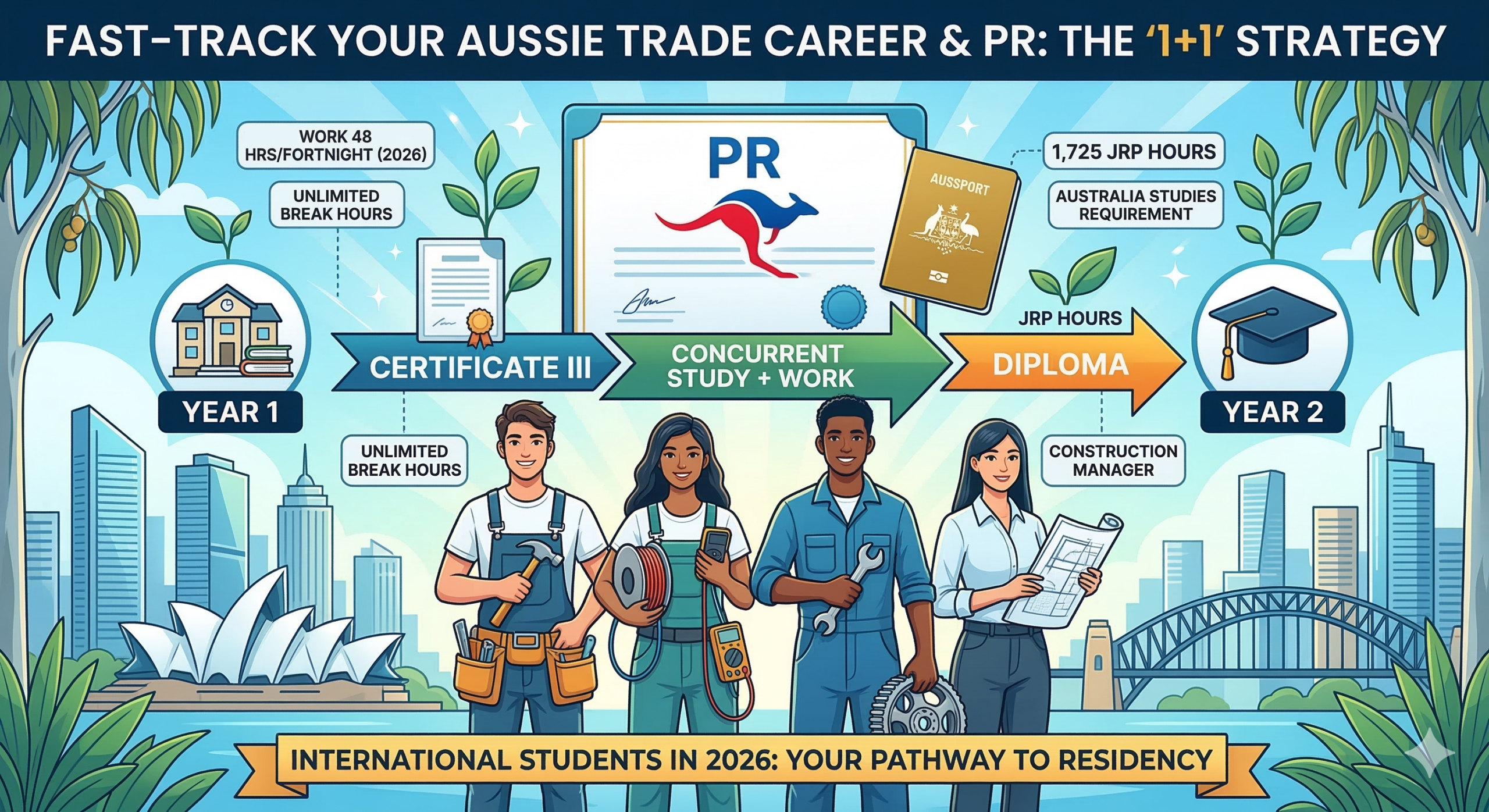
The Trades Job Ready Program provides international graduates with Australian qualifications a pathway to obtain a full skills assessment for migration. Participants demonstrate their technical abilities and workplace readiness through employment in their chosen trade. This program is a key requirement for many skilled visa applications in Australia.
Here is a detailed breakdown of the Job Ready Program (JRP) and a comparison of which Australian states are currently the most “trade-friendly” for Permanent Residency (PR).
1. How the Job Ready Program (JRP) Works (2026)
The JRP is a four-step employment-based skills assessment program run by Trades Recognition Australia (TRA). It is the essential bridge for international students moving from a 485 Graduate Visa to a PR visa (189, 190, or 491).
The Four Critical Stages:
Stage 1: Provisional Skills Assessment (PSA)
Goal: Prove your qualification is real.
Requirement: Complete your 2-year Australian trade qualification and prove you have done at least 360 hours of relevant work or vocational placement during your studies.
Outcome: This allows you to apply for your 485 Temporary Graduate Visa.
Stage 2: Job Ready Employment (JRE)
Goal: Start the clock on your work experience.
Requirement: Find a TRA-approved employer and register your job. You must complete at least 1,725 hours of paid work in your trade over a minimum of 12 months.
Key Document: You must keep a “Skills Progress Report” (SPR) detailing the tasks you perform daily.
Stage 3: Job Ready Workplace Assessment (JRWA)
Goal: Prove you can actually do the job.
Requirement: Once you have finished 863 hours (approx. 6 months), a TRA assessor will visit your workplace.
The Test: They will watch you work and interview you to ensure your skills meet Australian “trade-qualified” standards.
Stage 4: Job Ready Final Assessment (JRFA)
Goal: Get your PR-ready certificate.
Requirement: Once you complete the full 1,725 hours and pass Stage 3.
Outcome: You receive a Full Skills Assessment, which is the “golden ticket” required to lodge your PR Expression of Interest (EOI).
2. State Sponsorship Comparison (2026)
Different states have different “Priority Lists.” Choosing the right state can be the difference between waiting 3 years for an invite or getting one in 3 months.
| State | Top Priority Trades (PR Pathway) | Special Benefits |
| Western Australia (WA) | Mechanics (Heavy Diesel), Fabricators, Electricians | Highly prioritizes building/construction and mining trades for the 190 visa. |
| Queensland (QLD) | Carpenters, Plumbers, Bricklayers | Has a dedicated “Building & Construction Pathway” with lower points requirements for 491 visas. |
| South Australia (SA) | Motor Mechanics, Chefs, Tilers | Excellent for international graduates; offers long-term residency pathways for those working in regional SA. |
| Victoria (VIC) | Electricians, Plumbers, Construction Managers | Focused heavily on “New Energy” (Electricians) and large-scale infrastructure projects. |
| New South Wales (NSW) | Carpenters, Glaziers, Cabinet Makers | High demand in Sydney for finishing trades due to massive high-rise residential developments. |
Strategy Tip for 2026: The “Regional” Advantage
If you study and work in a Category 3 Regional Area (e.g., Adelaide, Perth, Gold Coast, or regional towns):
You get 5 extra points for Australian study in a regional area.
You get 15 extra points if the state nominates you for a 491 visa.
You often face much lower competition than in Sydney or Melbourne.
Which trade are you leaning toward the most? We can guide you which Australian city currently has the higher job vacancy rate for that specific trade.
In 2026, the short answer is: Yes, you almost always need to complete 2 years of study. While the trade qualification itself (like a Certificate III) might only take 1 year to complete, there is a major difference between getting the certificate and being eligible for a visa.
Here is why the “2-year rule” is the standard for international students:
1. The 485 Graduate Visa Requirement
To apply for the 485 Temporary Graduate Visa (which gives you the 18 months of full-time work rights you need to finish the Job Ready Program), you must meet the Australian Study Requirement.
The Rule: You must complete a course (or a combination of courses) registered on CRICOS for at least 92 weeks (2 academic years).
The Reality: If you only study for 1 year, you generally cannot get the 485 visa. Without that visa, you won’t have the legal right to stay and work the 1,725 hours required for your PR skills assessment.
2. How the “1+1” Model Works
Many students do not study a single 2-year course. Instead, they “package” two qualifications together to meet the 92-week requirement. Common examples include:
Commercial Cookery: Certificate III (1 year) + Certificate IV (6 months) + Diploma (6 months) = 2 Years Total.
Carpentry: Certificate III (1 year) + Diploma of Construction Management (1 year) = 2 Years Total.
Automotive: Certificate III (1 year) + Certificate IV (6 months) + Diploma (6 months) = 2 Years Total.
3. The “Fast-Track” Exception (Rare)
If you already hold a different visa that allows you to work full-time (like a Partner Visa or a 408 visa), you could technically just do a 1-year Certificate III and apply for a Migration Skills Assessment (MSA) instead of the Job Ready Program.
The Catch: This usually requires you to prove 3 years of full-time work experience (including experience from before or during your study). For most international students, this is much harder than just doing the 2-year study + JRP route.
Comparison Summary
| Study Duration | 485 Visa Eligible? | JRP (PR Pathway) Eligible? | Recommendation |
| 1 Year (e.g. Cert III only) | No | No (Usually fails 485 criteria) | Avoid if your goal is PR. |
| 2 Years (e.g. Cert III + IV) | Yes | Yes | Best Route. Standard for PR. |
Important Update for 2026
As of 2026, Trades Recognition Australia (TRA) has streamlined the first step of the Job Ready Program (the PSA). They have removed the 360-hour work requirement previously needed to start the program. This means as long as you have finished your 2-year study, you can register for the JRP immediately without needing prior work experience.
Yes, part-time and casual employment are absolutely acceptable for the Job Ready Program (JRP).
However, there is a specific “math” to how Trades Recognition Australia (TRA) calculates your progress. It is based on Full-Time Equivalent (FTE) hours, not just the number of weeks you have been employed.
Here is the breakdown of how part-time work affects your PR pathway:
1. The Magic Number: 1,725 Hours
To successfully complete the JRP, you must provide evidence of at least 1,725 hours of paid employment in your nominated trade.
Full-Time: If you work 38 hours a week, you hit this target in exactly 45.4 weeks (approx. 11 months).
Part-Time: If you work 20 hours a week, it will take you 86 weeks (approx. 20 months) to reach the same target.
2. The 12-Month “Calendar Rule”
Even if you work 60 hours a week and reach 1,725 hours in just 6 months, you cannot finish the program early.
TRA requires you to be in the program for a minimum of 12 calendar months from your “Job Ready Employment” (JRE) start date.
The Bottom Line: You can take longer than 12 months (if working part-time), but you can never take less than 12 months.
3. Updated Requirements Table (2026)
| Employment Type | Requirement | Impact on JRP Duration |
| Full-Time (38+ hrs/wk) | 1,725 hours | Can finish in the minimum 12 months. |
| Part-Time (e.g., 20 hrs/wk) | 1,725 hours | Will take approx. 20–21 months. |
| Casual | 1,725 hours | Varies. Depends on hours logged each week. |
| Multiple Employers | 1,725 hours | Allowed (up to 5 employers), but you must do at least 863 hours with one “primary” employer. |
Important: The 485 Visa Clock
This is the biggest risk for part-time students. The 485 Graduate Visa (Trade Stream) is typically granted for 18 months to 2 years.
The Risk: If you work only 15–20 hours a week, you may not reach the 1,725-hour requirement before your visa expires.
The Strategy: Most students aim for at least 30–35 hours a week to ensure they finish the JRP and get their Full Skills Assessment while their visa is still valid.
4. What counts as “Acceptable Evidence”?
TRA is very strict with part-time and casual workers. You must provide:
Detailed Payslips: Showing hours worked, hourly rate, and superannuation.
Bank Statements: Showing the wages being deposited.
Superannuation Records: Proving your employer is paying into your retirement fund (this is how they verify you aren’t working “cash in hand”).
Skills Progress Report (SPR): Signed by your supervisor confirming you performed the trade tasks during those hours.
Final Verdict on 1-Year vs. 2-Year Study
Because you need 12 months of work rights and 1,725 hours, a 1-year course is almost never enough because:
You won’t get the 485 Graduate Visa (which requires 2 years of study).
Without the 485 visa, you won’t have the time or the full-time work rights to finish the JRP.
This “1+1” model (Certificate III + Diploma) is a very popular “Fast-Track” strategy. Yes, you can absolutely start the Job Ready Program (JRP) while studying your Diploma, provided you have completed the prerequisite qualification first.
However, there is a specific sequence you must follow to make this work legally and effectively.
The “Concurrent Study + JRP” Timeline
| Phase | Activity | Visa Status | Work Rights |
| Year 1 | Complete Certificate III (e.g., Carpentry). | Student Visa | 48 hrs / fortnight |
| Gap Period | Apply for Provisional Skills Assessment (PSA) immediately after finishing Cert III. | Student Visa | 48 hrs / fortnight |
| Year 2 | Start Diploma of Construction Management. Once PSA is approved, register for Job Ready Employment (JRE). | Student Visa | 48 hrs / fortnight (60 hrs from July 2026) |
| Year 3 | Finish Diploma. Apply for 485 Graduate Visa. Finish remaining JRP hours. | 485 Visa | Full-time (Unlimited) |
Why This Strategy Works
Earlier Start Date: Instead of waiting until you graduate from your Diploma to start the JRP, you start the “12-month clock” as soon as your Cert III is finished and your JRE is registered.
Hours Accumulation: While you are restricted by the student visa work limit (currently 48 hours per fortnight), these hours still count toward your 1,725-hour total.
Holiday Bonuses: During official school holidays (between terms), student visa holders have unlimited work rights. You can work 40–50 hours a week during these breaks to “boost” your JRP hours significantly.
The “Math” of Doing JRP While Studying
If you work the maximum allowed on a student visa while studying your 1-year Diploma:
Study Weeks (approx. 40 weeks): 24 hours/week = 960 hours.
Holiday Weeks (approx. 12 weeks): 40 hours/week = 480 hours.
Total after 1 year: 1,440 hours.
By the time you finish your Diploma and get your 485 Graduate Visa, you would only need about 285 hours (approx. 7–8 weeks of full-time work) to finish the entire 1,725-hour requirement. This can save you nearly a year of waiting compared to the traditional route.
⚠️ Critical Constraints to Remember
PSA Prerequisite: You cannot register for the JRP (Stage 2) until you have received a successful PSA (Stage 1) outcome. You get the PSA based on your Cert III. You must apply for this the moment your Cert III results are released.
The 12-Month Rule: Even if you work extra hard and hit 1,725 hours early, TRA will not issue your final assessment until at least 12 months have passed from your JRE start date.
Occupation Match: Your work while studying the Diploma must be in the trade you studied in the Cert III. For example, if you did a Cert III in Carpentry, you must be working as a Carpenter while studying the Diploma of Construction Management. You cannot work as a “Manager” for JRP purposes; you must work in the technical trade.
Updated Strategy Comparison
| Feature | Standard “Wait Until 485” | Your “1+1 Concurrent” Model |
| Total Time to PR Assessment | ~3.5 to 4 years | ~2 to 2.5 years |
| Visa Used for JRP | Mostly 485 Visa | Student Visa + 485 Visa |
| Risk Level | Low | Moderate (Higher workload balancing study/work) |
Best Trade Courses for PR in Australia 2026: The Ultimate Comparison for International Students
With Australia’s construction and infrastructure boom reaching new heights in 2026, there has never been a better time for international students to consider a trade qualification. Vocational education offers a faster, more affordable route to a high-paying career and Permanent Residency (PR).
Trade Course Comparison by Industry
1. Electrical, Mechanical & Engineering Trades
| Trade Course | Annual Tuition (AUD) | Avg. Starting Salary | PR Demand |
|---|---|---|---|
| Electrotechnology (Electrician) | $10,000 - $18,000 | $70k - $95k+ | Exceptional |
| Engineering - Fabrication Trade | $14,000 - $18,000 | $65k - $85k+ | Very High |
| Automotive Mechanic | $10,000 - $18,000 | $55k - $75k | High |
2. Construction: Core & Structural Trades
| Trade Course | Annual Tuition (AUD) | Avg. Starting Salary | PR Demand |
|---|---|---|---|
| Carpentry & Joinery | $7,000 - $15,000 | $60k - $80k | High |
| Block & Brick Laying | $9,000 - $15,000 | $60k - $90k | Very High |
| Plumbing (General or Roof) | $8,000 - $16,000 | $60k - $90k | High |
The "Fast-Track" Strategy: The 1+1 Concurrent Model
As of 2026, the most strategic way to secure PR is the "1+1" model. This allows you to start the Job Ready Program (JRP) while you are still a student, saving you up to a year of waiting.
How it Works:
- Step 1: Complete a 1-year Certificate III (e.g., Carpentry).
- Step 2: Apply for your Provisional Skills Assessment (PSA) immediately. (Note: In 2026, you no longer need 360 hours of work experience to apply for the PSA).
- Step 3: Enroll in a 1-year Diploma (e.g., Construction Management).
- Step 4: Once PSA is approved, register your Job Ready Employment (JRE). You can now count your part-time work hours (48 hours per fortnight) and unlimited holiday hours toward the 1,725-hour JRP total while still on your student visa.
Pro Tip: By working part-time during your Diploma, you can finish nearly 80% of your required JRP hours before you even apply for your Graduate Visa.
2026 Vital Stats: Visa & JRP Requirements
Staying compliant is key to your PR success. Here are the current standards as of March 2026:
- 485 Visa Cost: Approximately $4,600 AUD.
- English Requirement (485): IELTS 6.5 overall (min 5.5 in each band) or PTE 55 (min Listening 40, Reading 42, Writing 41, Speaking 39).
- JRP Total Hours: 1,725 hours of paid employment over a minimum of 12 calendar months.
- Work Rights: 48 hours per fortnight during study; unlimited during breaks.
Top States for Trade PR in 2026
Where you study matters. These states are currently "fast-tracking" trade invitations:
- Western Australia (WA): Best for Mechanical and Engineering Trades (Mining focus).
- Queensland (QLD): Best for Core Construction (Carpentry, Bricklaying).
- South Australia (SA): Best for Finishing Trades and Commercial Cookery.
Conclusion
The "1+1" Concurrent Study strategy is the ultimate move for students wanting to minimize their time to PR. By starting your skills assessment during your second year of study, you hit the ground running the moment you graduate.
Would you like a custom 2-year timeline for your specific trade?